Feeds:
Posts
Comments

Posts Tagged ‘KDE’

Per chi stesse provando in questi ultimi giorni a (ri)compilare KDE trunk da SVN su Ubuntu Karmic, avrà notato l’evidente necessità di installare l’ultimissima release delle Qt, la 4.6 RC, peraltro già disponibile nel PPA experimental di Kubuntu; questa installazione ha però due drawbacks, che spiegano l’esistenza di questo post:

  1. se installate la RC nel vostro PC di lavoro, tutto funzionerà correttamente tranne… l’audio: la nuova versione di Phonon, infatti, pare abbia una qualche incompatibilità, che genera evidenti crash nelle applicazioni che lo richiedono. La soluzione è presto detta: forzate da Synaptic (o dal programma che usate solitamente) il pacchetto phonon-backend-xine alla versione 4.3.1-4ubuntu1, che è quella proveniente dai repository non sperimentali, e bloccate tale versione: tutto riprenderà a funzionare correttamente (e verificheremo quando uscirà la versione stabile se le cose si sono risolte).
  2. Il secondo problema coinvolge l’uso di Phonon fatto da KDE trunk: non è stato pubblicizzato il fatto che trunk ora dipende dalla distribuzione di Phonon in kdesupport, che normalmente è disabilitata in kdesvn-build, il set di script per compilare automaticamente SVN. E’ necessario, perciò, abilitarlo nel file di configurazione (dovrebbe essere sufficiente porre a ON la riga normalmente in OFF), ed a quel punto fare una fresh build di kdesupport.

A presto!

Read Full Post »

KDevelop

KDevelop

Penso sia l’IDE più colorato che si sia mai visto…

Read Full Post »

Due righe per sottolineare come da due giorni, o più precisamente dalla revisione 1047226, Virtuoso è divenuto una dipendenza obbligatoria di KDE trunk (e quindi lo sarà anche per KDE 4.4): con il passaggio a questo motore semantico, guadagnamo sia in velocità (è tutto C++, a differenza di Sesame che si appoggia a Java) sia in possibilità, finalmente, di eseguire operazioni di inferenza sulle triple RDF: anche se Virtuoso stesso non supporta appieno tutte le potenzialità offerte da motori dedicati, come Pellet o Fact++, ha comunque una serie di caratteristiche estremamente interessanti.

Chissà che finalmente gli utenti la smettano di lamentarsi inutilmente di Nepomuk ed inizino ad apprezzarne le caratteristiche!

Read Full Post »

Alcune note a margine del meeting with i ragazzi di Nepomuk, in italiano dato che sono comunque di minore interesse per il mondo 🙂

Innanzitutto, ho scoperto l’esistenza di un gioco da tavolo che ignoravo completamente, anzi che per la verità non avevo neanche mai visto; devo vedere come si chiama in italiano, è una sorta di Age of Empires da tavolo, in inglese credo si chiami “Settlers” o qualcosa del genere.

Il piccolo eee si è comportato egregiamente, pur con contemporaneamente Eclipse e VirtualBox attivi, entrambi in compilazione; l’unico dettaglio era il fatto che non mi ero copiato la configurazione di Eclipse dal Dell, così ad un certo punto l’ho abbandonato per KDevelop, che si è comportato abbastanza bene, sorvolando sul numero inguardabile di crash cui è soggetto (e la grafica dell’intellisense, copiata alla grande da Visual Studio); quindi, per il prossimo meeting, devo preparare un setup migliore.

Infine, tra il viaggio in treno e qualche momento libero ho prodotto un plugin per Remuco per poter utilizzare il cellulare come telecomando con OpenOffice Impress (tutto scritto in Python): ho realizzato un piccolo servizio DBus, che si collega in locale ad OpenOffice (che è necessario lanciare con una particolare opzione da linea di comando) ed effettua le richieste di avvio/stop di una presentazione, piuttosto che l’avanzamento delle slide; il secondo componente è un plugin per Remuco, che devo ancora testare per bene, che si collega a tale servizio e ne lancia i comandi, in base a quanto riceve dall’applicazione J2ME collegata via bluetooth; di fatto, sto sfruttando l’infrastruttura di base di comunicazione wireless di Remuco a mio uso e consumo (peraltro, ho scoperto che c’è già un plugin per Okular…).

Tutto l’insieme deve ancora essere un poco rifinito, e devo anche aggiungere qualche informazione aggiuntiva da trasmettere al telefono, ad esempio il nome della presentazione o lo stato di avanzamento, ma il più è fatto e dovrebbe essere ormai pronto; se c’è qualcuno interessato a giochicchiarci, mi faccia un fischio! (non vale la pena che stia ad aprire un progetto su Google Code per 4k di codice)

Per concludere: spettacolo il workshop, ho addirittura un paio di paper da leggere; non vedo l’ora che arrivi il prossimo! 🙂

Read Full Post »

So, my first Nepomuk meeting is over (as you will probably get to know from other sources), and here there are my impressions.

First of all, it has been a real pleasure knowing Sebastian Trueg and all the other guys (and the only woman, of course!) who met in Freiburg the last weekend; the place was quite cool (especially the fact that the conference room was just below the bedroom floor), and the surroundings were really beautiful.

Three devel days

Well, actually for me they were two and a half, because I arrived on friday noon, but anyway they have been surely interesting: I have to admit that I got a little lost in the first day discussion about some ontologies details; at least now I can say that I know something more about the Nepomuk internals.

On saturday the use cases discussion about social desktop and how to integrate it with the semantic one continued from the evening before, but we also started developing some things, about which I will tell in a few lines; I especially liked the sunday: we took one of the case studies, and each of us took a piece of the necessay libraries and tools that were missing from current Nepomuk release, with the aim to be able to make that use case real; we didn’t finish it, but it has been interesting and even fun to collaborate with the others with one common target.

My place in the world

So what was my part in all this? Well, I will start with the last day’s work: the use case was about allowing users to share metadata about files from a computer to another computer, so the user of the latter would be able to see those files in his searches, and to open them (downloading them on the fly) and add more metadata; anyway, I’m sure other people from the meeting will explain all this with more details.

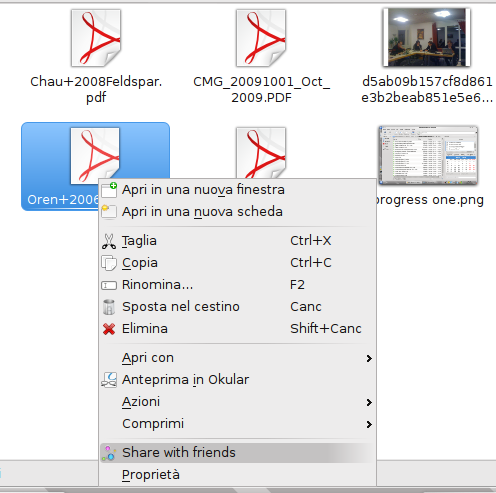
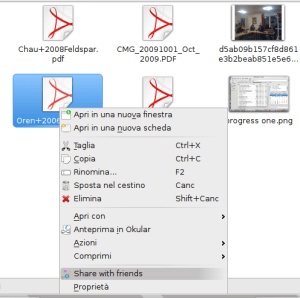
My task was to add a popup menu for Dolphin, so a user can right-click a document and decide to share it with friends; then a little dialog searches all the user’s contacts, allowing him to choose whom to share with and if he wants to be informed about any changes.
Konqueror plugin

Konqueror plugin

For now, I have been able to create a popup menu for Konqueror, in the form of a Konqueror plugin library, and later I will add it to Dolphin too (why Dolphin does not read also library plugins? It would be so useful…); what is missing in the plugin is just the final call to the Nepomuk service, of course through DBus, and this will be done in the next few days (and maybe I will blog about it later).

In this workshop I also wanted to share ideas about the smartsave dialog and its current status; for now, we decided to rethink about the filters UI, and put this new UI also in a Dolphin side panel, so users will start to see it and use it, and realize how useful it can be; this side panel may also be able to get into a KDE release easily.

Faceted panel - early preview

Faceted panel - early preview

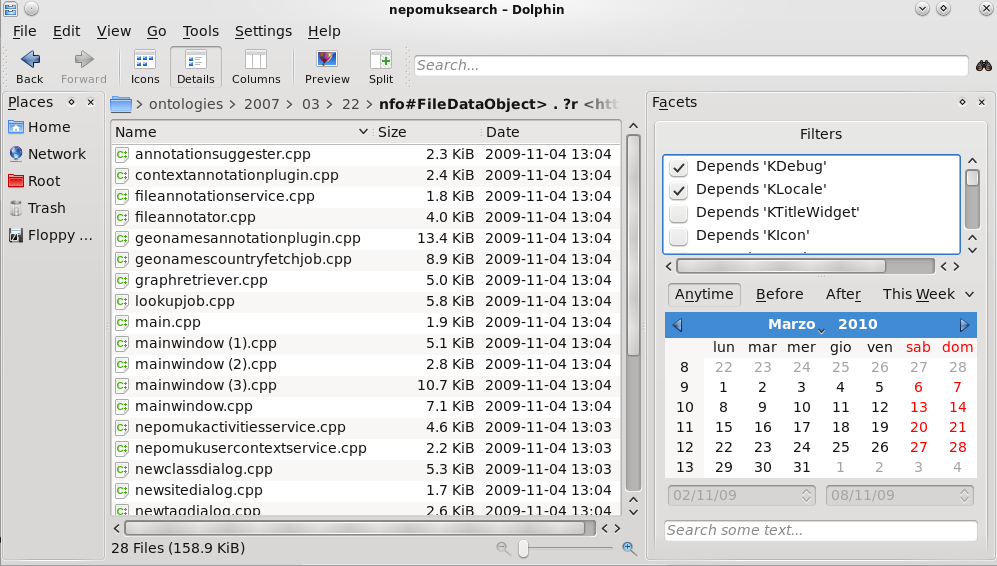
So what I did on saturday was to bring the filters panel, as it is now in the semantic open dialog, into Dolphin itself: the integration is still in an early stage, there are still some bugs to be solved, but it basically works; the next step will be to change the way in which filters are shown, and this even deserves a new paragraph.

Filtering

The filter panel will become a complete faceted browsing system, and we decided to reduce filter types to three categories (at least for now): time (today, yesterday, this week, last week, this month…), “rough” document types (documents, images, media…) and tags; probably contacts/people will be the next category to make its way into the panel, but at the current status it is not a priority.

I will prepare soon two different UI layouts, because there have been some debate in how to show these facets, and I think some screenshots will be better than lots of words trying to explain it, so for this you’ll have to wait 🙂

Final words

In the end, there have been three wonderful days, lots of fun and code and chatting and pizza and things; I really liked the whole meeting, and I hope I will be able to participate to the next one, too.

Read Full Post »

Brevemente (dato che sono a lezione), giro ai lettori una “chiamata alle armi” per il desktop semantico di KDE, tema che mi sta molto a cuore, più che altro perchè ritengo la semantica il futuro dell’informatica (banalmente…), sia in ambito desktop che in ambito Web.

Insomma, come scritto qui, se siete curiosi o interessati alla semantica, se avete un po’ di tempo da spendere per interessarvi a tecnologie decisamente eccitanti (e con possibili sbocchi accademici, se vi interessa ci sono fior fior di ricercatori che se ne occupano), fate un giro su nepomuk.kde.org, curiosate ed iscrivetevi alla mailing list ufficiale.

Non è un compito semplice, e non sempre è tutto facilmente comprensibile, ma vi assicuro che è indubbiamente tutto molto divertente!

Read Full Post »

If you don’t mind, I would like to leave for a moment the devlopment behind, and ask a question: what do you think about netbooks and development?

I mean, I would like to buy a netbook, and I’ve already found and affordable one, and I’m going to buy it for carrying it around at the university and in conferences, so I can access the Web, chats and things like that with a light instrument; what I’m asking is: for your experience, how is using a netbook in events like hackmeetings or development meetings, for example like the “KDE projectname sprint” ones?

I have already experienced programming on an Atom (I have an eeebox at home, and I had to use it for a couple of weeks while waiting for my new notebook), and of course I had been able to develop some code without much fuss, yes I had to wait some time while recompiling code, but not that much in the end, so is it worth bringing a netbook to that kind of meeting?

The positive aspect is that a netbook is light in dimensions and weight, and I can survive on a 10″ screen for a few days (I had a friend who survived on a 7″ screen for a year!), and I can bring it with me every time (I don’t want to leave a computer in a hotel room, for example…).

Please, comment and tell your opinion! 🙂

Read Full Post »

Dopo il wrap up del Google Summer of Code, ora anche il mio mentore, Sebastian Trueg, ha scritto sui risultati raggiunti finora, ed il lavoraccio degli ultimi 10 giorni ha permesso di arrivare a quanto potete vedere negli screenshots pubblicati finora; c’è ancora da lavorarci, ma già adesso una prima preview (potremmo definirla un’alpha release?) è già usabile.

Sebastian ha pubblicato anche la guida per la compilazione, che vi riporto anche qui:

  1. c’è prima di tutto da applicare una patch alle kdelibs, che speriamo venga integrata per KDE 4.4 ma compatibile anche con la versione 4.3;
  2. poi basta scaricare il modulo di Nepomuk in playground e compilarlo: potete installare tutto oppure compilare ed installare i soli sottomoduli scribo, nepomukutils, annotation e smartsave; consiglio anch’io comunque di installare tutto;
  3. infine è necessario modificare i kdeglobals inserendo una nuova voce, file module=smartfilemodule, nella sezione dedicata a KFileDialog ed alle sue impostazioni.

Ho comunque le migliori intenzioni di preparare sia una versione modificata delle kdelibs 4.3 per Ubuntu, con la patch già applicata, ed un pacchetto contenente il modulo aggiuntivo; tenete d’occhio il mio account su Launchpad per gli aggiornamenti del caso.

Chi l’avrebbe mai detto, ormai 6 anni fa, quando ho installato la mia prima distribuzione Linux (Mandrake) e KDE, che un giorno sarei stato citato dal blog di uno dei maggiori sviluppatori di KDE stesso (l’autore di K3b prima e di Nepomuk ora)… 😀

Read Full Post »

KDE 4.3 codename Caizen

KDE 4.3 codename "Caizen"

Read Full Post »

Ok, this may be my first and last post about Summer of Code 2009!

I’m participating to the selections phase for a KDE Nepomuk project, about which I will write extensively if my proposal will be accepted, and here I’m publishing the application, in its original PDF version, to be linked from the SoC page on Google.

It contains almost the same things that I wrote in the application form, plus a couple of notes; anyway, without further ado, GSoC 2009 application!

Read Full Post »

« Newer Posts - Older Posts »