Feeds:
Posts
Comments

Archive for the ‘Virtual world’ Category

The first official SoC week is gone! A bit of a hard work, but good results obtained…

With the last smartsave commit, all the stubs are done and real code is coming out: all the base classes are being populated, and in a few days some UI may come up.

I’m especially working in the save part of the system, still from the backend point of view, with models and signals that come and go through the classes (test 2 already shows something of this), updating views when new annotations come up. A hard link to the annotation framework (in playground) is coming out, and probably one of the two exposed classes will be collapsed to that framework, when my experiments and my messing up the API will stabilize a little.

The most difficult part, I must admit, has been to adapt to Qt frameworks (signal-slot, model-view, d-pointers), which are pretty different from my last C++ works or from the Java approach, so a big thank goes to Sebastian Trueg for his advices on them.

Besides, I hope not to flame in any way, but I really have some difficulties in understanding why the d-pointer idea… for example, I see the model-view as some kind of a derivative of MVC, and signal-slot as an alternative to a callback system; I see why calling getter methods with the variable name (C# does something similar), but why can’t I put my private members directly in the class? I read about the binary compatibility, but those are still private members, so the outside world cannot see them. So why complicate the classes structure with all those private classes with public members?

So, C++/Qt masters, I’d really like to read your opinion on that, not for flaming (I repeat), just for deeply understanding this way of programming 🙂

And, stay tuned for UI updates in the next few days!

Read Full Post »

Signore e signori, e musica fu!

Con il fondamentale apporto di Sante, oggi ho finalmente sperimentato a fondo le potenzialità multimediali di Linux; la scheda audio esterna USB della Terratec, gentilmente sponsorizzata dall’uomo di cui sopra, ha un ingresso mono funzionante sotto il nostro sistema operativo preferito, così ho potuto registrare in lungo ed in largo nel pomeriggio.

Ardour 2

Ardour 2

Qui sopra potete vedere Ardour 2 con tutte le tracce di “I am the highway” degli Audioslave, versione almost unplugged (ho solo l’acustica qui a Milano); naturalmente, basso e batteria non sono miei ma vengono dal MIDI della base.

In primo piano ci sono le opzioni del plugin LADSPA per applicare il delay all’assolo del brano: anche se non è semplice come in Audacity applicare gli effetti, se la cava comunque bene (sono riuscito a fare anche l’effetto reverse, volume swallow o chiamatelo come vi pare, dell’intro).

Unico difetto, volendo, dell’esperimento è stata la necessità di eseguire sia qjackctl che ardour da root, e se il kernel real time mi funzionasse decentemente (that is, non mi mandasse il pc in freeze al boot), magari la latenza sarebbe stata inferiore ai (credo) ~6 ms misurati.

Audacity

Audacity

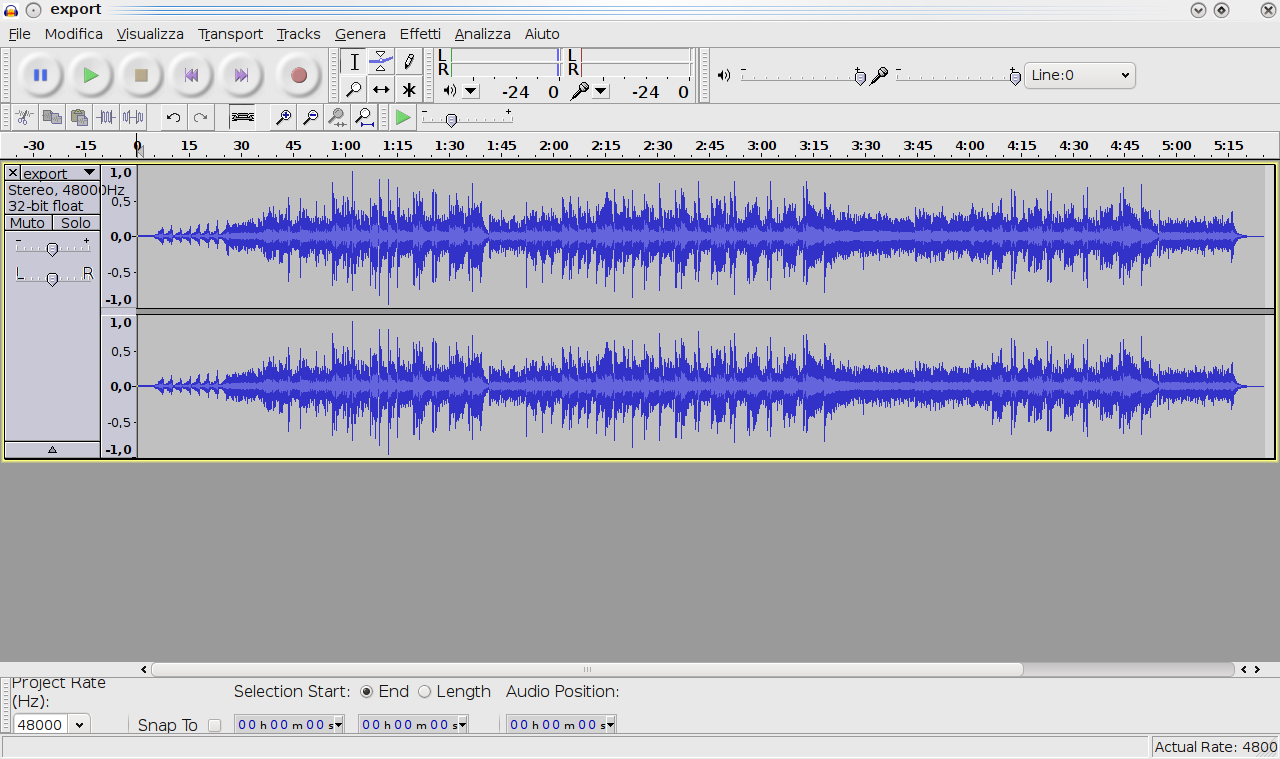
Audacity, alla fine, mostra il file wave finale dell’opera d’arte…

La versione conclusa non è male, anche se penso che sarebbe meglio mettere un amplificatore tra la chitarra e l’ingresso (o comunque una scheda dedicata per poterci agganciare direttamente lo strumento), per diminuire alcuni fruscii di fondo. Comunque direi esperimento perfettamente riuscito e assolutamente replicabile!

Edit: oggi ho provato Rakarrack: spettacolo! Ecco un primo esperimento: Delayed improvisation

Read Full Post »

Father, yes, I am a prisoner
Fear not to relay my crime
The crime is loving the forsaken
Only silence is shame

And now I’ll tell you what’s against us
An art that’s lived for centuries
Go through the years and you will find
What’s blackened all of history

Against us is the law
With its immensity of strength and power
Against us is the law!
Police know how to make a man
A guilty or an innocent
Against us is the power of police!
The shameless lies that men have told
Will ever more be paid in gold
Against us is the power of the gold!
Against us is racial hatred
And the simple fact that we are poor

My father dear, I am a prisoner
Don’t be ashamed to tell my crime
The crime of love and brotherhood
And only silence is shame

With me I have my love, my innocence,
The workers, and the poor
For all of this I’m safe and strong
And hope is mine
Rebellion, revolution don’t need dollars
They need this instead
Imagination, suffering, light and love
And care for every human being
You never steal, you never kill
You are a part of hope and life
The revolution goes from man to man
And heart to heart
And I sense when I look at the stars
That we are children of life
Death is small

Read Full Post »

This week has seen my first (and second, by the way) commit into KDE SVN! Another milestone reached 🙂

There are mostly stubs into the new smartsave/ folder, and a bit of documentation for the interfaces; there also is a test program, taken from one of Techbase tutorials: a very simple notepad, which will be the very first application to use the new dialog system, and it will be useful for trying functionalities.

No, don’t try it now: it just falls back to the standard KFileDialog class; let me write some real implementations before toying with it!

For now, the idea is to have an abstract class, Nepomuk::SuggestionProvider, which may be subclassed by any application (there’s, for now, just a method to be implemented), and an instance of it will be passed to the dialog UI for getting personalized suggestions, in form of Nepomuk::Annotation objects. These objects need to be created by the developer in the way he wants, by hand or using any Nepomuk::AnnotationPlugin, but things may change later on.

The second important class is Nepomuk::KSmartDialog (I called it ‘K’ just to mimic KFileDialog, but if you don’t like it, I can drop that ‘K’), which is a subclass of the actual file dialog, and which will provide a couple of static methods for getting or setting document metadata; of course, each of these methods will use the SuggestionProvider subclass as stated before.

These are the two important exported classes, at least today; expect some working code in the next days!

Oh, by the way: tomorrow is the official GSoC start! Godspeed to any GSoCer around PlanetKDE!

Read Full Post »

Read Full Post »

System UML 2

System UML 2

I promise: this will be the last image!

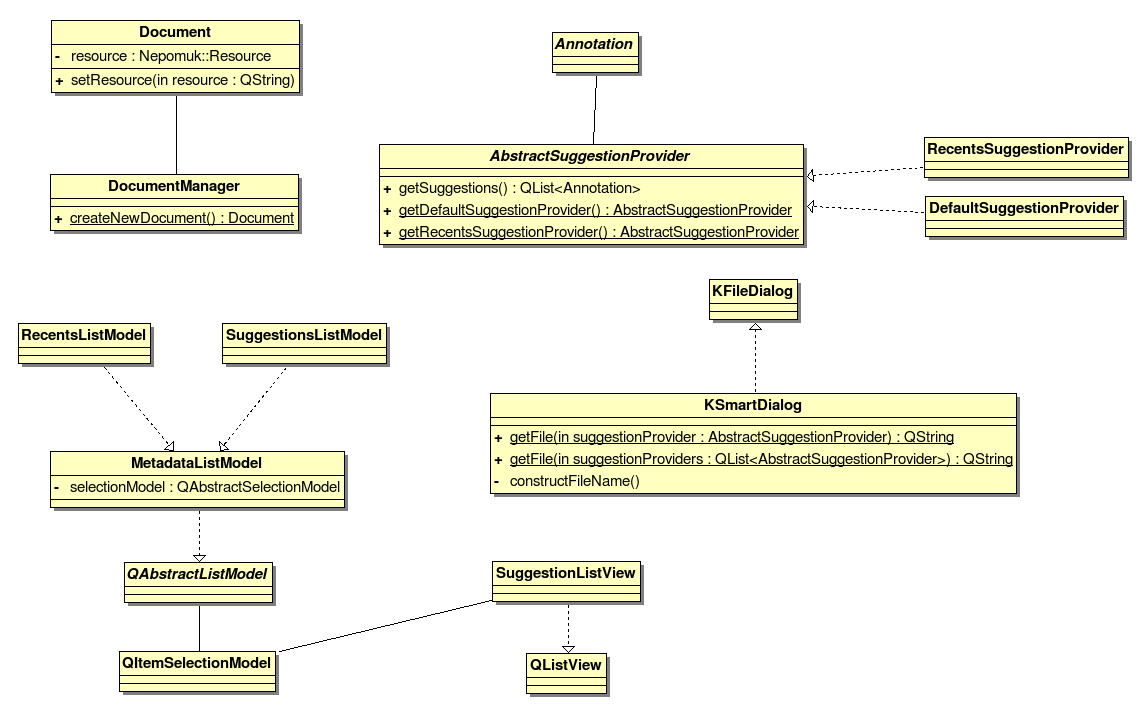
The next post will discuss a bit about real code (which is coming, I just have to check the very first compilation cycle before throwing a new folder into playground); for now, here is an update of the previous UML diagram: it’s a little bit more into the “real virtual world” of KDE libraries, even if something could be changed any time.

I’m studying the model-view framework from Qt, and a few classes are now related to the abstractions offered by that system; as soon as the structure will be clear, I will write about it.

Next week, waiting for the GSoC official start (on saturday the 23rd), the first classes will come up and I will talk about something a little less into the air and a little more into the bits.

Read Full Post »

System UML 1

System UML 1

And here we go with another image!

Ok, as an instrument for making everything a little more clear, I made a class diagram (yes, UML…), which shows a high level view of how the dialog system may show up in a few weeks.

Now, I use UML in the Fowler’s way, so the final system may look completely different from this one, or the diagram may change accordingly, mainly because of two things:

  • this is not completely integrated with the Qt/KDE dialog classes, essentially because I’d like to have some backend system working before planning that part deep;
  • the SuggestionProvider and the integration with the Annotation Plugin already present in playground is still a work in progress: in particular, I still think that giving an abstract class to be subclassed by KDE developers is better than a pure function to be called, but anyway I may change my idea on that, we’ll see.

So, expect something to come up (soon?) under playground/base/nepomuk-kde/smartsave (nice name, uh?), waiting for the official GSoC start in 9 days…

Read Full Post »

Synesis 2009

Io: … bè, siamo un’associazione studentesca che si occupa di diffondere presso gli studenti il software libero…

Lei: Ah, anch’io ho la mail su Libero!

Read Full Post »

Corsi Linux 2009

Corsi Linux 2009

Cominciano mercoledì prossimo, 13/05, i corsi su GNU/Linux, organizzati dall’associazione POuL; il programma è ricco, dettagliato e soprattutto “hands on”, e verranno mostrati alcuni dei programmi più famosi e/o più utilizzati in campo office, multimedia, sicurezza, internet.

Nella lezione del 13, inoltre, il sottoscritto terrà una (piccola) introduzione sul mondo multimediale: riproduttori audio/video ed un po’ di editing musicale (cui seguirà un articolo sul prossimo numero del Giornalinux).

Mi raccomando, partecipate numerosi: non ci sono limiti di posto o di presenza!

Read Full Post »

DISCLAIMER: these images are here just to show you which blocks will be present in the end, they will not be used as they are. They are a proof of concept.

As promised, here are a couple of drafts (have you noticed the bold font?) for the future UI: they are not meant to be the definitive interface, they are here only to show what widgets/views will (probably) be in the final dialogs.

Load dialog

Load dialog

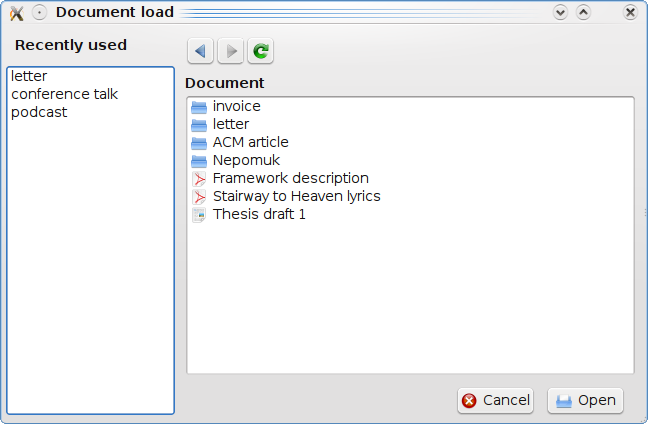
The load dialog is very similar to the actual load dialog: instead of folders, the central view will show metadata (here represented with the “folder” icon) and files associated with the tags already selected (and written in the breadcrumbs). When you will “enter” a metadata, view and breadcrumbs will be changed accordingly.

On the left there is a panel showing the recently used tags, so you will be able to use them as shortcuts.

Save dialog

Save dialog

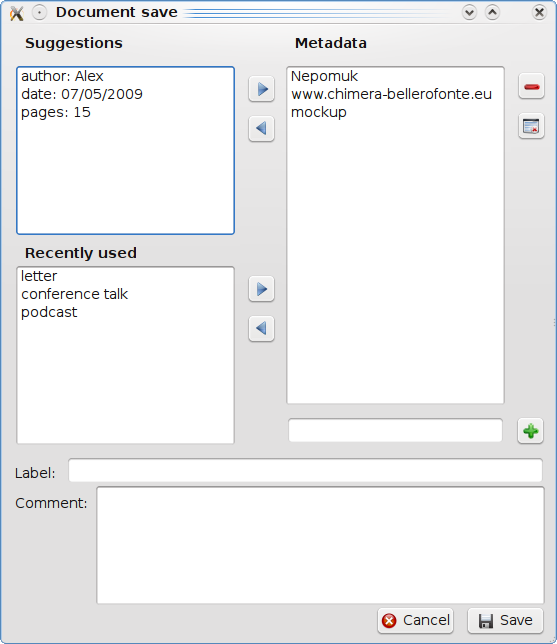
Ok, the save dialog will probably be completely different: on the right, there will be a view with the list of metadata that the user has chosen to associated to the current file; on the left, a view will show the recently used tags (as before), and another view will collect suggestions given by the program (and the program itself will provide them, using some internal logic).

At the bottom, the label of the document (or resource, as called in semantic terminology), which will be the final filename (even if it will be completely trasparent to the user), and a space for a comment to the file, maybe automatically filled by the program, as before.

So, that’s it! You can see some changes in respect to the actual system, probably the saving system will be the main change.

Stay tuned, as I am studying how to realize the internals of the project, so soon there will be some ideas (or even diagrams!)…

Read Full Post »

« Newer Posts - Older Posts »