The greatest danger to good computer science research today may be excessive relevance. If we can keep alive enough openess to new ideas, enough freedom of communication, enough patience to allow the novel to prosper, it will remain possible for a future Ken Thompson to find a little-used Cray/1 computer and fashion a system as creative, and as influential, as Unix.

Scrivania
Posted in Real world | Tagged Arduino, elettronica, informatica, lavoro | Leave a Comment »
Privacy is a value so complex, so entangled in competing and contradictory dimensions, so engorged with various and distinct meanings, that I sometimes despair whether it can be usefully addressed at all.
Posted in Citazioni | Tagged Citazioni | Leave a Comment »
Semmai a qualcuno servisse, la matricola del contatore dell’elettricità di a2a (e AFAIK pure dell’Enel e magari di qualche altra marca) è quel codice stampato sul contatore stesso del tipo N. XX XXX XXX.
E no, non era così ovvio…
Posted in Real world | Tagged appartamento, contatore | 3 Comments »

The Witcher - Epilogue*
* Immagine tratta dall’artbook di “The Witcher Enhanced Edition – Director’s Cut”
Posted in Virtual world | Tagged informatica, videogiochi | Leave a Comment »
Posted in Real world | Tagged politica, USA | Leave a Comment »
Quasi quasi me la perdo: la trovate qui!
Posted in Virtual world | Tagged Arduino, informatica | Leave a Comment »
After having seen many versions on Internet, I have just created my own theremin using Arduino! Nothing too much fancy, just a couple of sensors and a VST on software side, and that’s it. Here are the details…
Hardware
From a hardware point of view, the circuit is quite simple: I am using two IR proximity sensors, connected to two analog input pins of the Arduino Uno, plus a couple of leds, which increase their light in proportion to the readings from the sensors, and a couple of pushbuttons, useful for blocking the values sent to the computer (regardless of the readings).
I have also changed the Arduino firmware, as indicated here, using this one, so that the Arduino itself is seen from the computer as a MIDI device, instead of a USB-to-serial port; this has been easy enough: just a 10K resistor is required, soldered in the position indicated on the guide, and then a couple of commands and the new firmware is up and running. Of course, you will need to change it with the standard one quite often in the beginning, before settling the final version of the sketch (which can be uploaded only with the USB-to-serial code). Note that this operation can be done only on an Arduino Uno.
As you can see, the device is correctly shown in QJackCtl:
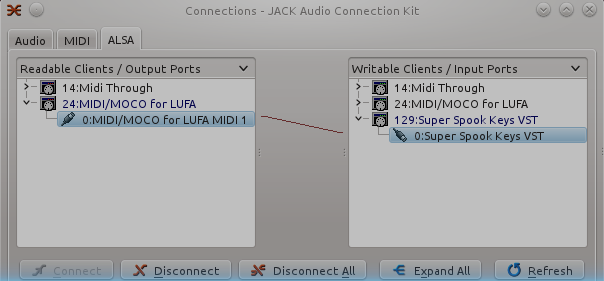
QJackCtl Alsa view
Software
On the software side: first of all I have searched for an existing program which could reproduce the Theremin sound: there are a few, one very interesting is written in Python but it works only with OSS, and the Alsa emulation does not work at all (Ubuntu does not support OSS since a couple of years); there is also a CSound library, but it did not sound that well. In the end, I have decided to use this free VST effect, which is not free software (unfortunately), but has many different options and it also shows a MIDI input, so it can be driven using MIDI CC #60 and #61 (for x and y directions).
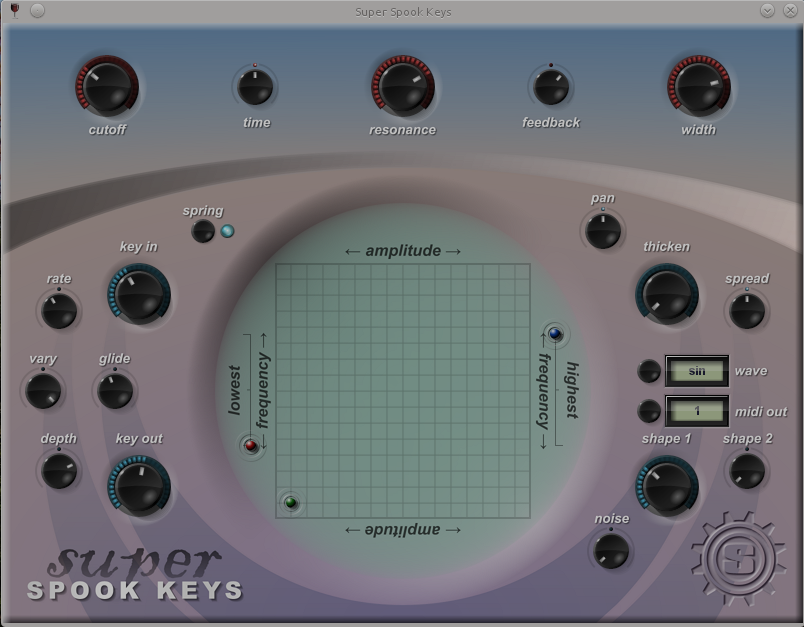
Super Spook Keys
The Arduino program is very simple: it reads values from both the sensors, collecting five consecutive values; after that, it computes the mean of the values (for smoothing the signal) and sends it through the serial line as MIDI messages, then it repeats. The two leds are set a value proportional to the sensors, and if one of the two buttons is pressed, the corresponding sensor is blocked to the last valid value, so that (for example) the volume can be blocked while the pitch is changed, or viceversa.
Conclusions
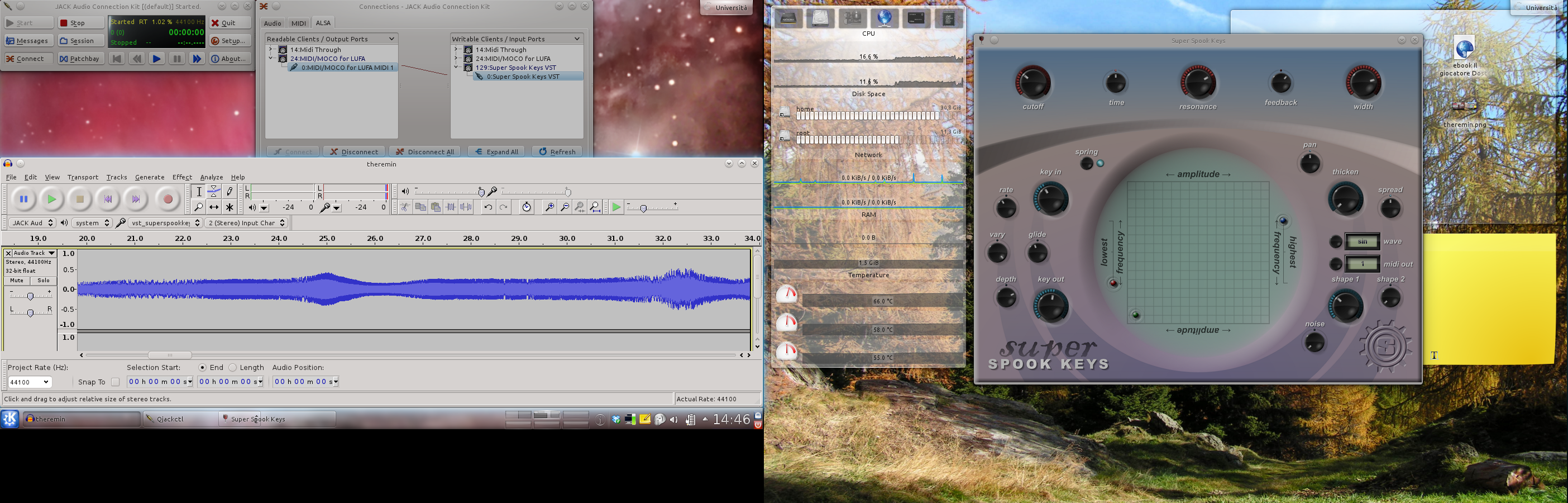
Recording session
Quite fun, again: I have also added all the components to a prototipying shield, so that as soon as a new enclosure arrives, I will be able to move everything together and close up my third Arduino circuit of the summer; you can briefly see part of that shield in the first video, although it is not in use yet.
Let me know if you want any detail…
P.S.
Webcam recording on Linux (or, at least, on Ubuntu 11.04) sucks: mencoder exited with floating point exception ( :-O ), ffmpeg just crashed, the same for Cheese; in the end, GStreamer saved me (and allowed me to easily record the second video), with the definitive pipeline:
gst-launch-0.10 v4l2src device=/dev/video1 !
 'video/x-raw-yuv,width=640,height=480,framerate=30/1' !
 tee name=t_vid ! queue ! xvimagesink sync=false t_vid. !
 queue ! videorate ! 'video/x-raw-yuv,framerate=30/1' !
 queue ! mux. alsasrc device=hw:0,0 !
 audio/x-raw-int,rate=48000,channels=2,depth=16 ! queue !
 audioconvert ! queue ! mux. avimux name=mux !
 filesink location=webcam.avi
Posted in Virtual world | Tagged Arduino, informatica, musica, theremin | 7 Comments »
Linus Benedict Torvalds
Aug 26 1991, 2:12 amHello everybody out there using minix –
I’m doing a (free) operating system (just a hobby, won’t be big and
professional like gnu) for 386(486) AT clones. This has been brewing
since april, and is starting to get ready. I’d like any feedback on
things people like/dislike in minix, as my OS resembles it somewhat
(same physical layout of the file-system (due to practical reasons)
among other things).I’ve currently ported bash(1.08) and gcc(1.40), and things seem to work.
This implies that I’ll get something practical within a few months, and
I’d like to know what features most people would want. Any suggestions
are welcome, but I won’t promise I’ll implement them 😀Linus (torvalds@kruuna.helsinki.fi)
PS. Yes – it’s free of any minix code, and it has a multi-threaded fs.
It is NOT portable (uses 386 task switching etc), and it probably never
will support anything other than AT-harddisks, as that’s all I have 😦 .
Posted in Virtual world | Tagged informatica, linux | Leave a Comment »
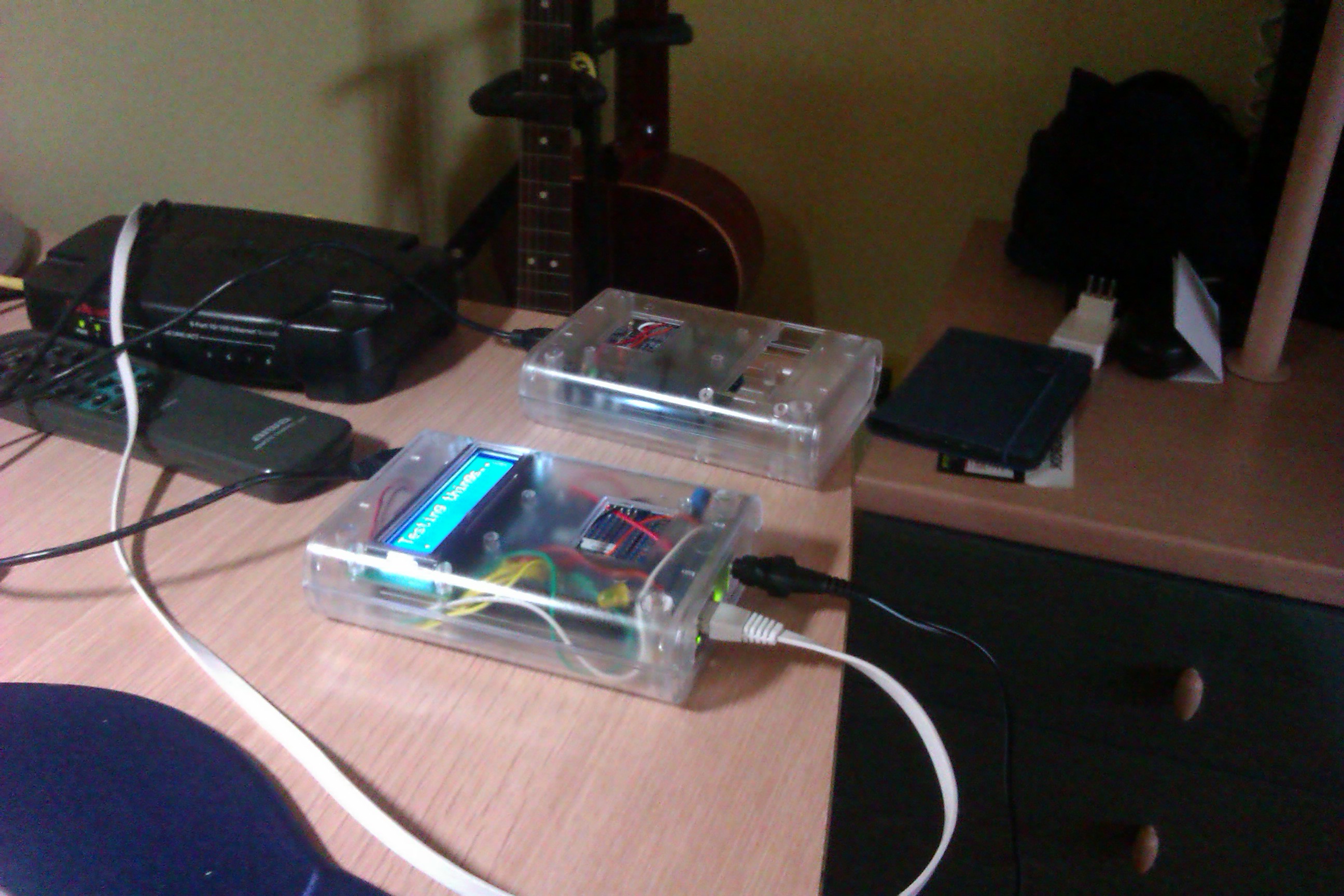
Arduini
Oggi è arrivato l’LCD da 16×2, e così ho potuto inscatolare il secondo dei miei due progettini estivi fatti con l’Arduino; come potete vedere in figura:
- sullo sfondo c’è un lettore ad infrarossi, che ho accoppiato al telecomando (sulla sinistra) del mio vecchio impianto stereo; per interfacciarlo al PC, dato che francamente con LIRC non ne sono uscito, mi sono scritto 20 righe di Python e comando direttamente Amarok via DBus; presto aggiungerò qualche riga per comandare anche VLC, ed a quel punto direi che è fatta… il circuito ha praticamente solo il ricevitore IR (ed un LED, tanto per illuminare qualcosa), quindi lo sforzo è stato decisamente basso.
- In primo piano, invece, c’è il buon Tweetino: è un po’ un peccato che lo schermo adatto a quel case sia necessariamente così piccolo, per il resto tutto funziona egregiamente; dopo aver risolto il bug della libreria Base64 ed uno stack overflow che mi era sfuggito, l’interfacciamento sulla rete non dà problemi ed i tweet vengono correttamente visualizzati (spesso abbreviati) sullo schermo. Devo ammettere che scrivere il software è stata la parte più divertente, e vedere il tutto funzionare correttamente è decisamente soddisfacente.
E questo è quanto: ormai l’estate è finita (anche se Qualcuno lassù ha evidentemente sbagliato ad impostare il termostato…), e devo ricominciare a fare cose serie; in realtà è rimasta una piccola ideuzza, ma per attuarla devo aspettare che mi arrivino alcuni componenti (tra cui un accelerometro, e non dico altro…). Nel caso, scriverò ulteriori aggiornamenti.
Posted in Virtual world | Tagged Arduino, informatica | 1 Comment »
The Author
Tag Cloud
amarok Android appartamento Arduino audio Barack Obama basso blog C++ carambola chitarra Citazioni computer corsi Linux eeepc elettronica ELIoT Erlang esami Facebook fantascienza Fender Google gsoc guitar hardware HWProjWeek iCTF ieee immagini informatica Intel Internet Italia Java KDE kde4 Kindle LaTeX laurea lavoro libri linux LinuxDay mandolino Matlab Microsoft Milano musica Nepomuk notebook planetkde polinux Politecnico politica portatile POuL repository Sacco & Vanzetti seggio semantica Sembrowser sito Studio Siv Tesi TV Ubuntu università USA Varie video videogiochi vita web WSNUtilities

 Syvo3
Syvo3 